Civic Engagement for Social Good
Inspiring community collaboration and meaningful change


Introduction
The world needs people committed to understanding social issues and collaborating alongside their communities to create meaningful change. In Civic Engagement for Social Good (CESG), previously known as CIVICUS, students work with organizations addressing a range of societal challenges, including poverty, food and housing insecurity, child welfare, education, political activism, animal rights, and the environment. In CESG, students explore:
- Issues impacting local communities;
- Organizations addressing pressing social issues;
- Ways to engage in hands-on work in civic engagement;
- Strategies for deliberative dialogue; and
- Methods to leverage their academic and career interests to make sustainable change.
CESG coursework and community engagement activities operate in tandem. Coursework helps students to understand the root causes of issues and strategies for addressing social concerns, while service projects, civic engagement work, and co-curricular activities create opportunities for students to complete hands-on work with communities while earning course credits.
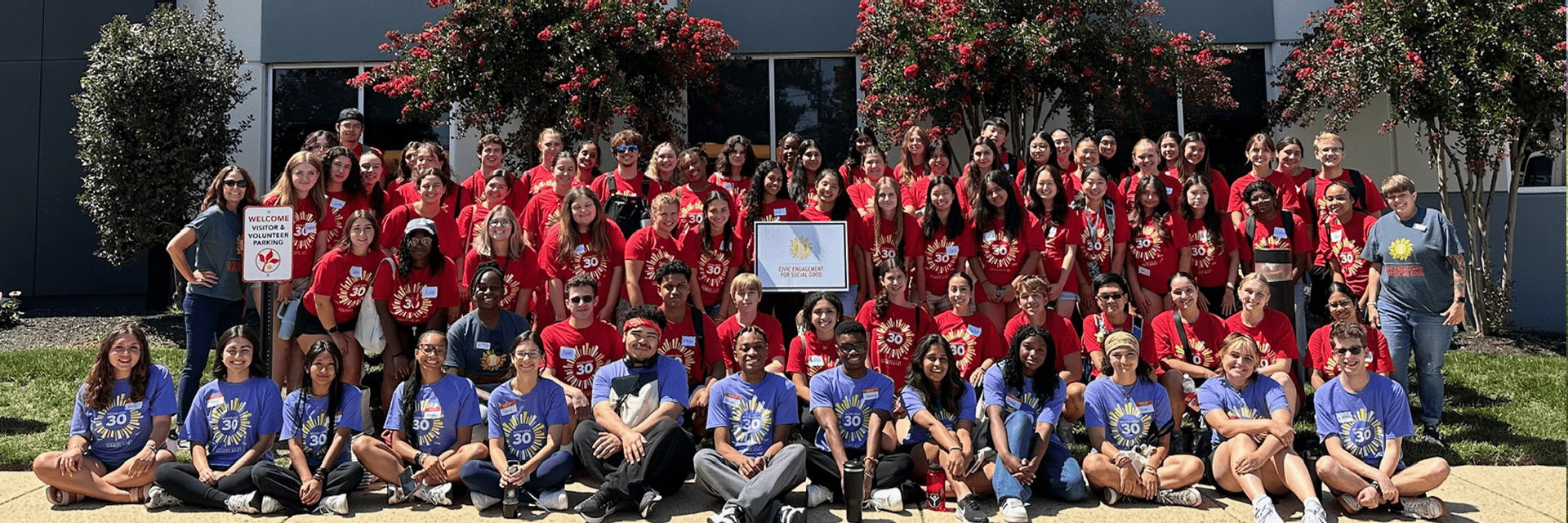
As an interdisciplinary program, Civic Engagement for Social Good encourages students to ground their work in their passions, academic majors, and professional interests. Our students represent all thirteen colleges, with majors ranging from engineering and biology to business and education.
Through their shared passion for creating social good and engagement in co-curricular activities, CESG students form a close cohort who develop strong friendships and support each other throughout their time at UMD.
Colloquium and Lecture Topics
- The complexities and structures that cause social issues
- Theories and practices of civic engagement
- Models for working toward positive social change
- Ways to engage in difficult conversations with empathy
[This program] has made me a kinder, more compassionate, more informed person. [It] gave me the opportunity to get my hands dirty, to engage in the community in ways I never thought I could. [It] has taught me that it takes a village but also that I can make tremendous change myself..providing me with more opportunities for learning and character-building than I would've gotten in any other program or club.
Other Learning Opportunities
Students are actively engaged in UMD, College Park, and the broader Washington D.C. community. Annually, cohorts of CESG students have completed over 1,500 hours of volunteer work. Students can choose from over 100 projects per year with a wide array of partner organizations.
Students:
- Participate in civic engagement projects. For example, students have acted as mentors for local elementary students, planted trees to increase the canopy in Washington, D.C., provided support to patients in medical facilities, served meals from a mobile soup kitchen, handled dogs at rescue adoption events, canvassed on behalf of political candidates, and captioned videos to ensure accessibility for a wider community.
- Take trips to Washington, D.C. and the surrounding area to participate in scavenger hunts, visit memorials, monuments, and museums, dine in historic restaurants, and attend baseball games, cultural heritage events, and the performing arts.
- Meet guest speakers, including politicians, staff members from local non-profit organizations, and community leaders and activists.
- Travel out of town to places like New York and Philadelphia to learn about civic engagement work in other cities.
- Participate in community-building activities, such as challenge courses, trivia, game nights, and study breaks.
Second-year students participate in a capstone experience for academic credit consisting of either an internship, extensive service work, research, or affiliated experiential learning courses. Students have held internships in places like local and national politics, non-profits, high-profile media outlets, medical facilities, research labs, mentoring organizations, and peer dialogue training. Examples of past internships include: Capitol Hill, the Center for Early Childhood, the Department of Health and Human Services, the Maryland General Assembly, the National Institutes of Health, Pregnancy Aid Center, UMD Athletics, A Wider Circle, the White House, and many more. The capstone gives students authentic experiences and skills that help support their academic work, career goals, and future community engagement efforts.
Curriculum Overview
Over the two-year program (four semesters), students complete the 13 credit hours required for their CESG Scholars citation and many fulfill General Education requirements. The following table represents a typical two-year curriculum. Details about courses and requirements can be found on the CESG Citation Checklist.
| SEMESTER | COURSE | CREDITS |
|---|---|---|
| Semester 1 | CPCV 100: Colloquium I | 1 credit |
| CPCV 225: Intro to Civic Engagement for Social Good | 3 credits | |
| Semester 2 | CPCV 101: Colloquium II | 1 credit |
| Semester 3 | CPCV 200: Colloquium III | 1 credit |
| CHSE 228C: Intergroup Dialogue (DVCC) | 1 credit | |
| Semester 4 | CPCV 230: Internship; or CPCV 240: Service-Learning; or CPCV 250: Research; or |
3 credits 3 credits 3 credits |
| Semester 1, 2, 3, or 4 | Supporting Course (var. Gen Ed) | 3 credits |
Sponsoring College
Office Address
1103 Centerville Hall
Office Email
Faculty